Description
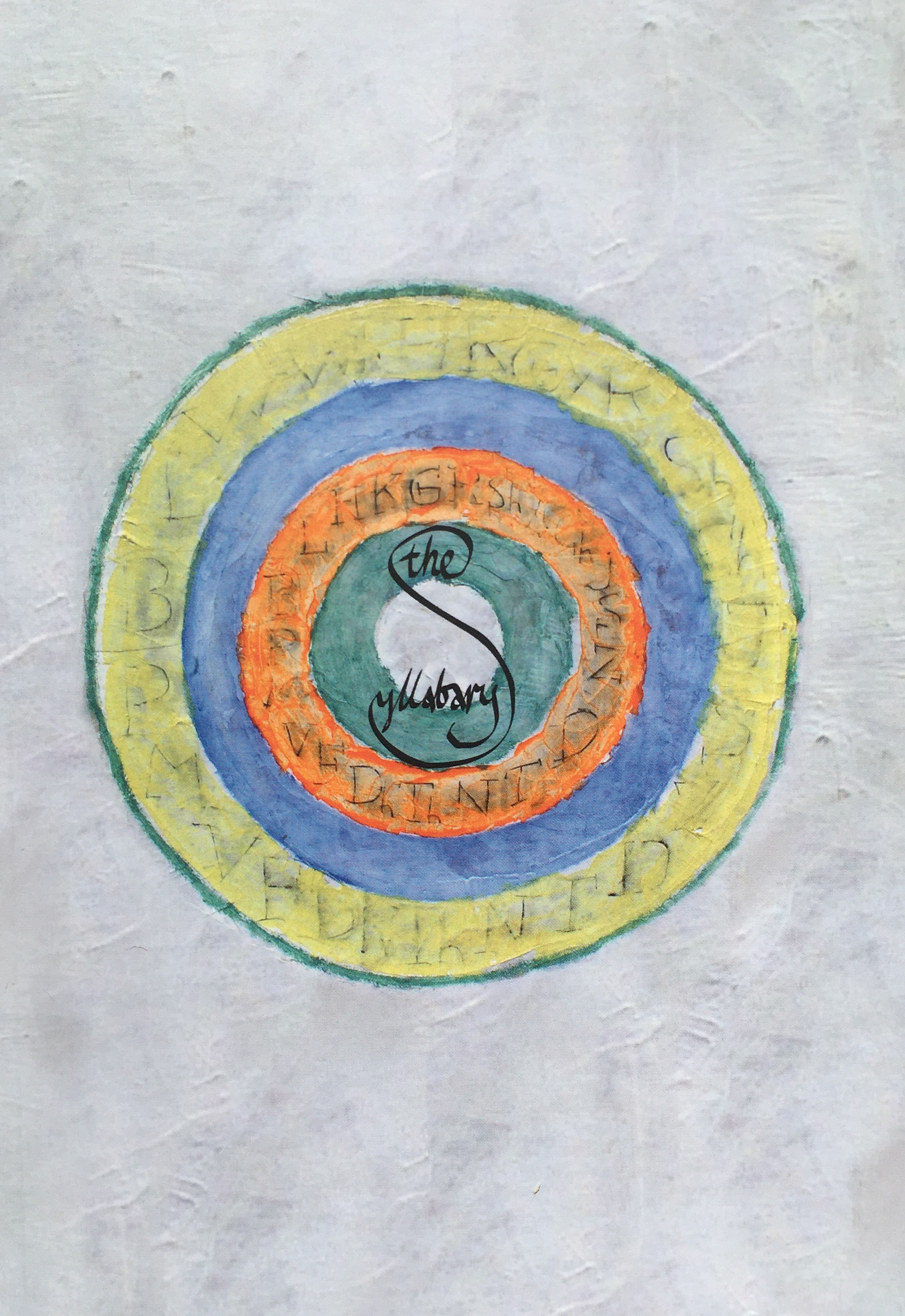
The Syllabary, begun in the 1990s and completed in 2023, put its ear to the ground and listened; it consists of 1,328 empty sounds and 2,272 spoken parts of 1 to 37 lines in length, each based on a cluster of between 1 and 47 monosyllabic words.
The Syllabary is a printed book in eleven volumes, with different complete sequences published in runs of 25 copies each.
It is also an audiovisual sequence at www.thesyllabary.com, which starts at random and leads the viewer to the next verse in any of three directions, ad infinitum.
And it is designed for physical installation in an urban setting.
There are two essay-reviews of The Syllabary, one (below) in PN Review and one (just after this paragraph) in Painted, Spoken. Here we go:
Review by Ben Holden
I
The second print run of Peter McCarey’s Syllabary project has landed, courtesy of the poet’s own Molecular Press. The limited edition print run of 25, released last year, goes by the title of its first randomly-selected poem; therefore in this review I am referring to the winningly-dubbed PINE edition. Its precursor is the audiovisual sequence at www.thesyllabary.com which starts at random and leads the viewer to the next verse in any of three directions, ad infinitum. The syllabary.com runs off a server in Switzerland, and has received over a million visits. The audiovisual format is still the best way to experience The Syllabary. I particularly like left-clicking and sliding the mouse across mouse mat between poem readings, which sends me/the viewer spinning off through the black, white and grey (but mainly white) deep space of Glaswegian McCarey’s ‘demotic texts’. And it is a pleasure to hear McCarey – poet, linguist, translator – read his masterwork (for, taken as a whole that is what it is), and to experience the comforting, plangent serendipity of the site’s algorithmic wanderings. The project looks past the book as a poetic medium, self-evidently rejecting the ‘slim volume’ in favour of a kind of forbiddingly-large textual mise-en-abyme, or an interactive Escher lithograph or mezzotint literary epic, where every flight of steps goes back the way it came.
McCarey conceived of his project in 1992 and completed it in 2023, with some updates thereafter. “It consists of of 1,328 empty sounds and 2,272 spoken parts of 1 to 37 lines in length, each based on a cluster of between 1 and 47 monosyllabic words” (from the Molecular Press website). Got that? No, I didn’t either, but the reader just has to dip in and all becomes clear. McCarey’s rationale? He wanted to subvert his own predilection for writing narrative poems in favour of an English language syllabary’s necessarily randomising constraint. To every spoken syllable in Scottish English and Scots its poem. The resulting free verse fragments, always aphoristic and witty, range from the ethereal to the anarchic. His comic timing is worth the admission fee alone. He had recourse to the ten Scots or Scottish English vowels of his Cessnock in Glasgow dialect, is another of the interesting bits of context I have acquired during my reading of at least 3kg of the eleven volumes’ 5kg (shoddy, I know).
Cutely, the poems then reach the reader in randomised order. It is one of the most achieved online poetic experiences available. It is also an immersion in the Present – though each poem is undated, they feel fresh, like sketches. In other words, we read what McCarey’s pen thinks, on at least 2,272 poetic occasions, over a 25-year period. For fifteen years during this time, he was Head of Language Services at the World Health Organisation, for which he travelled a lot. While the occasional poem bemoans the ‘day job’, this does make his career trajectory a bit more ‘real world’ – and European – than the average British or Irish poet’s.
So why this rather expensive eleven volume print version? In his book of stylish essays on poetry and artistic collaboration Orasho (Red Squirrel Press, 2022), McCarey writes that over twenty years thesyllabary.com had been through four different programming languages, necessitating its future-proofing in print (I proffer that this unstable era in history might be usefully coined The Librarian’s Turn). In return for this deviation from the initial concept, readers get one of the best collections of short poems they are likely to read, with the psychedelic bonus of McCarey’s ‘Lanark’-ian glyphs (aides de memoire during his writing process) set below the poems, pictorially. The sheer number of demotic texts, none of which cross the page, and which are often one or two-liners, is not unrelated to this success. This endless register of experiment has a cumulative, antic effect. Whatever comes within a poem’s range surprises. In the majority of the poems the sound and sense are interwoven excitingly: McCarey has a good ear. The higher the repetition of a monosyllable’s semantic cluster-words in a poem, however, the more Stockhausen-esque discordant it becomes. Such are the improvisational moves McCarey is fated to display in these tight, self-imposed, Houdini-like constraints:
When straights in suits, their shaded gaze,
Steaks instead of ears, close cranial scrapes,
Bone up on the chicanes and straits
A renegade lone ranger strafes,
Gerrymandered stripmall scrapes,
The final frontier,
What slakes a thrust (…)
(“Exchange Value”)
The poems span tiny one-liners (the smallest and bravest is “Feel free”) to syntactically complex medium-length poems, and there in size they stop, none crossing the page. McCarey’s lyric persona is sardonic, philosophical, rueful. Lonely sometimes: an omniscience eternally complicating and uncomplicating its lines, in the larger silence of this Death Star-sized project’s white space.
There are many kinds of poem here, perhaps 2,272 different kinds. One never steps into the same Syllabary twice. While disdaining categorising – or my own at least – I did venture to spot reoccurrences: the physical poem, the democratic poem, the aphoristic poem, the commuter poem, the instructional poem, the cosmology poem, the translation poem, the Scottish poem (MATE: “Yaw right mate? Aye, maw right”), the demonic poem, the European poem, the ars poetica, the nonsense poem, the theological/philosophical poem, the love poem… Though he excels in all of these, my favourite perhaps is the scary poem, of which there are only two. The beauty of writing about these books is that I can quote these two poems in full:
LOPES / LOESS [this title is invented by me, they are the syllables represented by McCarey in glyph-form, his aides de memoire)
Thermal twist on the valley floor
And a figure rises out of the loess five mile off.
South it lopes and gone.
Never saw such a thing.
Not scared yet? How about the second:
EELS / EAVES / EASE / EARS [see above]
A lot of white cats are blind. This one
Appears to have no eyes. Scratched out?
It cowered at my approach. I said
Don’t worry, cat, don’t fret,
And strode on past. It belted after me.
I hear the sunrise, eels in puddles,
Icicles on wooden eaves above them: this is good.
The lost causality of rhyme
Is not. I wait
Have eels rained from the sky? Or have they been dumped by a street-seller? No, I rather think, that the sunrise sounds like eels in puddles. Which is terrifying – to me anyway! Meltwater communicating with (and wriggling in) the sun. Is the piece of jargon “lost causality of rhyme” there for pathos, or bathos? Rhyme: the useless poetic weapon abjured by trends? Hmm…hardly. Does he “wait” for this lost causality of rhyme to reinstate itself, via the blind cat catching up with him? I am put in mind of Sadegh Hedayat’s Blind Owl.
II
Many of the poems are fingers-and-thumbs tactile. You can feel your hand (or the hand of someone observed) in the following poem, a simple image of delving. The metaphorical ‘spatulate fingers’ accurately gets the two-or-three finger operation this would both look and feel like. Its final deliberate baccy-ish tangle comes from the proximity of ignite to align, causing me to momentarily read align as alight. It is physical and painterly, with the lack of punctuation seemingly exhaling its conclusion into the air.
DELVE
Spatulate fingers delve
Into their soft tobacco pouch
Teasing out an excerpt
From the over-written scribble
To align on petal paper
And ignite
The majority of poems in the book are untitled, save for the syllable or syllables denoted by the glyph. The syllables that generate the following lyric, in which the poet wakes up to himself (literally) are spoke, stroke, smoke, stoke, and soak. The physicality of morning’s discombobulation, tiredness after lack of sleep…
In crumpledom I stoke
My syncopated self with breakfast. It
Had kept on missing in the night
The pedals of its pushbike. Run on
Smoke it chugged on sand. Refloat
With soak soak water. What a frail
Spoke in the wheel, my one-stroke engine.
The metaphor lands nicely: the one-stroke engine could be the teller’s heartbeat; his body; his remaining lifetime. The alternating bike and boat metaphors power each other in the final line – sleeplessness is cycling (haplessly); showering is the refloating of a small motorboat with the shower-burbled-phrase ‘soak soak water’. Not being able to handle a night out as well as might once have been the case?
There are literary jokes, artfully done, such as:
THROATS
Her ankles
Rilke said
Were like drinking throats.
What was her throat like.
And perhaps the best short poem on a major American poet (Wallace Stevens):
LUNCH / LUSH
“Wallace in Florida”
The metaphors are lush. The major
Man is out to lunch.
III
In Peter McCarey’s House there are many Rooms in which (think the Grand Budapest Hotel) reside Alexander Blok, Simone Weil, Bach, Duns Scotus, Tom Leonard, TS Eliot, Edwin Morgan, Hugh MacDiarmid, Christopher Middleton, Simone Weil, Paul Celan, Les Murray, Mikhail Bakhtin, Raymond Queneaux, Machiavelli… In other words, influences abound but rarely show themselves, and then only explicitly in two fine elegies for Douglas Oliver and Alexander “Sandy” Hutchison. McCarey’s voice is all his own.
IV
In some of his essays in Find an Angel and Pick a Fight (Molecular Press, 2014), McCarey discusses metaphysics, expounding persuasively on Dante’s The Divine Comedy, Aquinas, Catholicism, Aristotle, and the Buddha. This Switzerland-based south Glasgow Scot, whose father and grandfather worked for Glasgow shipbuilders; who is fluent in Russian and French; can seem the very reincarnation of a cultured medieval Italian. However, the poems artfully lift clear of philosophica theologica. Rhythm is their religion. And McCarey’s priority is to reach across time to the reader:
RANGE
Learn and forget
As much as you can
Till the rage for it leaves you
With or without what you need.
Then range the world for things
The next won’t have to forget.
IV
The Syllabary is the equivalent of thirty-five standard poetry collections, this means a productivity rate of 1.4 slim collections every year. I imagine the median in poetry is for poets to publish a new full collection every three years or so – and despite McCarey’s running the WHO’s languages department for much of this period, authoring non-fiction books and collaborating with international poets and artists in locations such as Geneva, Glasgow, Siberia and Macau, as recalled so engagingly in Orasho – McCarey’s production rate, far from being tardy (25 years? One book?) is actually prolific. This opinion may surprise
In Orasho’s concluding essay ‘De L’Oubli’, McCarey describes his political-poetic credo – internationalism, Scottishness, politico-poetic resistance, the polyglot world fighting back against the English language’s flattening influences. He also proffers the whimsical-cum-satirical idea that as a poet, one sets loose a hard-won poem upon the world in zombie form – a Frankenstein’s monster. This reminds me of the well-worn poets’ cliché (albeit true) of letting a long-edited poem loose to go and live in the world. Time to let the public have it: fly fly fly. Never finished, only abandoned.
I am glad that Peter McCarey is letting his 2,272 poems fly. The Sisyphean challenge was so great as to constitute a quarter century self-heckle. On the evidence at least – the joie de vivre evident in each poem – he seems to have loved writing it. This 5kg of bravura experimentation, philosophizing, lit-crit raspberry blowing, demotic pratfalls, and dizzying plunges into the sorrowful global present, by its ex-Eurocrat writer, should in a just world, pack the bookshelves and glim from the bedside tables of anyone who enjoys pots of gold at the end of their literary rainbows. It’s a Glaswegian-Genevan tilting at windmills; a paradox unto itself; an Ouroboros; a poem of everything… do get on board.
In PN Review, Philip Terry writes:
“While the rest of us worry about the future of writing in the age of AI, the poet Peter McCarey has been busy creating his own breed of writing machines, more like the imaginary creations of William Heath Robinson than the slick machines of AI. McCarey has been doing this for some time – his volume Collected Contraptions appeared in 2011 – but his most recent work, The Syllabary (A Poem in 2,272 Parts), simultaneously published online and in book form (the book runs to eleven volumes), takes this to a new level. The result is one of the longest poems in the language, rivalling Michael Drayton’s Poly-Olbion of 1612, which ran to 15,000 lines.
“In the Foreword to the printed version (a limited edition of twenty-five, each weighing around 5kg) McCarey cryptically describes the mechanism as follows: ‘The Syllabary sets every monosyllabic word of my ideolect in a matrix of 20 initials, 10 vowels and 18 terminal consonants or nonsonants. Of the 3,600 [20 x 10 x 18] cells in the matrix, 2,272 contain a word or cluster of words. There is a glyph to every cell, and a lyric to each word-bearing glyph.’ If this leaves you puzzled, the workings of McCarey’s machine become luminously clear when you read the online version of the book. Here the reader enters what at first seems like an endless labyrinth – a ‘3D map’ where there ‘is no telling where it will take you’ – but its fundamental mechanism quickly comes into focus. The first thing you see, turning to the bottom right-hand corner of the webpage, is a wheel, or three wheels, one inside the other, the outer wheel bearing consonants (the twenty initial consonants), the middle wheel vowels (the ten vowels), the inner wheel more consonants (the eighteen terminal consonants), and when the turning wheels come to rest they highlight a sequence of letters: HAM, LEB, HAL, YEL and so on. In the case of YEL (one of the 2,272 cells that contains a word), once the wheel stops, a handwritten glyph appears, spelling the word YELL, then we hear the poet read a poem generated by the word:
To yell at your colleagues
Is maybe cathartic
But not, in the long run,
That wise.
“On other occasions the three letters in the wheel give rise to more complicated glyphs, where by the insertion of additional letters, multiple words are created, as in YEARN, which is the basis of the poem ‘Yen’:
I yearn for you
But never learn. For you
I’d die my dear, but don’t.
“And then there are numerous poems which take this process as far as it can go, giving rise to complicated glyphs that by inserting extra letters create matrices of overlapping words. In the following example, the glyph
containing the words ‘gunge’, ‘gulch’, ‘grudge’, and ‘grunge’ forms the building blocks of the following poem:
There’s some gunge in the gulch
You could guddle for bargains
That nobody’d grudge you
So lee aff the grunge.
“The method, which you can begin to glimpse here, frequently gives rise to poems built around clusters of similar-sounding words, something which many traditional poets achieve by employing end rhyme, but here the music is created within the lines as well as at the end. This makes for an original and arresting soundscape, very different, in fact, from any use of rhyme, end rhyme or internal rhyme alike, for here the echoing sounds are constantly metamorphosing and diverging as we read. And it gives space to the reader, too, not just in allowing them to participate in the act of composition, by seeing the writing process as it unfolds, but in the latent suggestion that each poem, each word cluster, could be resolved in different ways, be rewritten by each reader. In a work containing 2,272 poems, inevitably some will be better than others. Several of the pieces here are throw-away two-liners, though even these are often infused with sardonic wit: ‘In the random snooker hall of physics / Life’s a glitch’. Occasionally, too, the poem strains to encompass the words thrown up by the machine, like a juggler presented with too many balls, but in the vast majority of cases, and triumphantly in others – as in the moving poem in memory of the poet Douglas Oliver – the poems rise to the occasion, at once enabled by, and transcending, the machine out of which they are born.”
(PN Review 278, from the essay “What is Poetry?”
Read more about The Syllabary: